AI Support for the Humanities @ Princeton
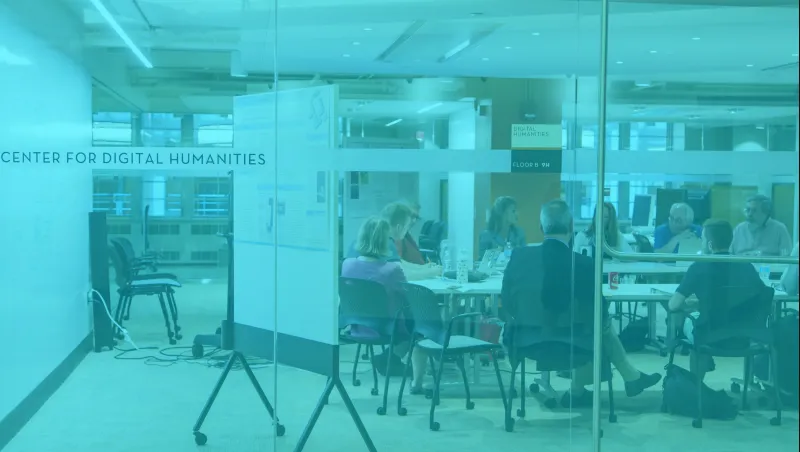
For Princeton humanities departments:
While Princeton has no shortage of AI resources, we at the Center for Digital Humanities (CDH) understand that humanists need to engage with AI on their own terms. For more than a decade, the CDH has been the main campus resource for engaging with computation and AI from the perspective of humanities research. CDH faculty and research staff offer a range of discipline-focused information, guidance, and resources on the role of AI in humanities research. (Teaching and pedagogy and AI are largely covered by the McGraw Center.)
Schedule a visit to a faculty meeting or a stand-alone session in your department this spring. Please reach out by December 10, 2026.
CDH offerings in Humanities and AI
1. Department visits
- Faculty or department meetings. We can lead or co-lead a session at a faculty meeting or other department meeting, working with the chair to set the agenda and main points, and involve any faculty already working on AI in the humanities in your unit.
- AMAs. Modeled on Reddit’s “Ask Me Anything,” these sessions combine a general introduction to data, computation, and AI in research with open discussion. We work with department officers beforehand to understand your needs, and we answer discipline-specific questions directly. We can hold separate sessions for faculty and for graduate students.
2. Individual consultations
We welcome any research question, with no judgment. Most of our consultants are domain experts with PhDs in the humanities. Book a time at cdh.princeton.edu/consult.
3. Events, seminars, and co-sponsorship.
Any department or faculty member can propose an event or talk, whether AI is the subject or the method. We’ll help find the right support and promote it.
The CDH approach to AI
The core work of the CDH is to build bridges between humanities research and emerging technologies, whether in theory, method, or practice. Since our founding in 2014, we have helped hundreds of Princeton scholars engage with new technologies in a responsible, balanced, and historically informed way. We treat the humanities and computation as reciprocal partners: computational methods can enrich our study of the human record, while core humanities principles (critical thinking, contextual understanding, creativity, close reading, and attention to the diversity of human perspectives, values, and histories) must guide the development of fairer and more inclusive technologies.
We recognize that generative AI is bringing profound and often disorienting changes. We also see it as the latest chapter in the long history of humanists engaging with technological innovation. Our team ranges from AI early adopters to skeptics, and all of us bring respect for the research, social, and human questions at stake.
We begin from the lived experience of humanities faculty, including the grief and anger that AI provokes for many. We take seriously the political economy of “AI” and its ties to the corporate concentration of wealth. We advocate for open-source, open-weight, non-corporate, and no-cost models where possible. At the same time, many closed models offer real benefits, so for faculty and graduate students who choose to use them, we teach ethical practices and strict privacy and security protocols. For faculty who prefer not to use AI at all, we stress that it is now embedded in search engines and everyday research tools, and that their graduate students will need their guidance in navigating it.