Meredith Martin
Faculty Director
Ph.D. Comparative Literature, University of Michigan
- mm4@princeton.edu
- 609-258-1863
- 19 McCosh Hall

Meredith Martin is Professor of English and Faculty Director of the Center for Digital Humanities at Princeton, which started under her leadership in 2014. Her book, The Rise and Fall of Meter, Poetry and English National Culture, 1860-1930 (Princeton UP, 2012), was the winner of the MLA Prize for a First Book, the Warren Brooks Prize for Literary Criticism, and co-winner of the Sonya Rudikoff Prize for the Best First Book in Victorian Studies. Her second book Poetry’s Data: Digital Humanities and the History of Prosody (Princeton UP, 2025) argues that poetry can teach us how to think critically about data, and that critical data studies can teach us something about how we read poems. With several collaborators, she has been building since 2007, the Princeton Prosody Archive, which contains writing on poetics, prosody, rhetoric, grammar, speech, and literary history published between 1570-1923. That archive of materials has been transformed into datasets which form the basis of several ongoing computational projects about how to read historical data about poems. Fall 2026 special issues in Victorian Poetry and The Journal of Cultural Analytics are dedicated to the literary and computational work that the PPA database and datasets have inspired. In 2015, Martin received the Andrew W. Mellon New Directions Fellowship for research on the ongoing project Before We Were Disciplines: Poetry at the Origin of Language. She is co-writing Data Work in the Humanities with Zoe LeBlanc, Assistant Professor in the School of Information Sciences at the University of Illinois, Urbana-Champaign and former CDH Post-Doctoral Fellow. She is working with a team at Johns Hopkins on the Schmidt Sciences Grant “A Toolkit for finding latent hierarchical structure in humanistic data.”
With Megan Ward (OSU) and Sarah Reif-Connel (Princeton), Martin is co-editor of the Nineteenth-Century Data Collective. Since 2024, Martin co-edits the Journal of Cultural Analytics with Dr. Amelia Acker (Rutgers University) and Dr. Cecily Raynor (McGill).
In her committee work across campus and at the Center for Digital Humanities, Martin centers humanities questions into the AI curriculum. Courses that include significant content on AI, data, computation, and the humanities can be found under the “CDH” subject code for both undergraduates and graduate students. For more information on humanities and AI curriculum, look into the graduate certificate in Digital Humanities.
Martin advises graduate students who are thinking about poetry, Digital Humanities, critical data studies, critical archival studies, computational literary studies, the history of poetic forms, comparative and Anglophone poetry, disciplinary, history and the history of education, and literary study in relation to other disciplines. In 2021 she was the recipient of the Princeton University Graduate Mentoring Award by the McGraw Center for Teaching and Learning and is devoted to mentoring graduate students with both rigor and compassion. In 2023 she received the Clio Award from the Princeton Graduate School for significant contributions to Princeton Graduate student’s professional development.
Martin is committed to the often-invisible labor of building infrastructures to support the creation of new knowledge — and new ways of communicating that knowledge — both in the humanities and across the humanities-oriented disciplines. She is Associated Faculty in the Program in Media and Modernity and the Center for Information and Technology Policy and serves on the Steering Committee for the Humanities Initiative, and is on or has served on several committees working on Data Science initiatives and curriculum at the intersection of humanities and AI. She is one of the Co-PIs of the newly launched Princeton Societal AI Initiative in the Data and Intelligent Systems unit, https://societal.dais.princeton.edu/.
Martin is happy to serve as an advisor, reader, or co-advisor for projects that help undergraduate students complete the requirements for the Minors in Computer Science, Statistics in Machine Learning, Journalism, Computing, Society, and Policy, or the Keller Minors in Design, Technology and Society, or Entrepreneurship, alongside the varieties of Minors also listed on the English Department website. She teaches undergraduate courses in 19th-century poetry, 20th-century poetry, Literature and War, Poetry and Public Culture, Introduction to Poetry, Children’s Literature, and Data and Culture.
All graduate admissions at Princeton go through the graduate school. Inquiries about joining the CDH or Martin’s research lab from prospective graduate students are not appropriate. She directs the graduate certificate in Digital Humanities but it does not, itself, admit graduate students. Her students work in 19th-century studies, modernist studies, and media studies, and tend to focus on poetry and/or the intersection of science and technology studies, literary studies, and the humanities as a discipline.
For all general questions about humanities and AI or Digital Humanities at Princeton, please see cdh.princeton.edu. If you have an idea for a project or would like to request a consultation, please start at the Center for Digital Humanities Consultations page.
Selected Publications
Recent Work
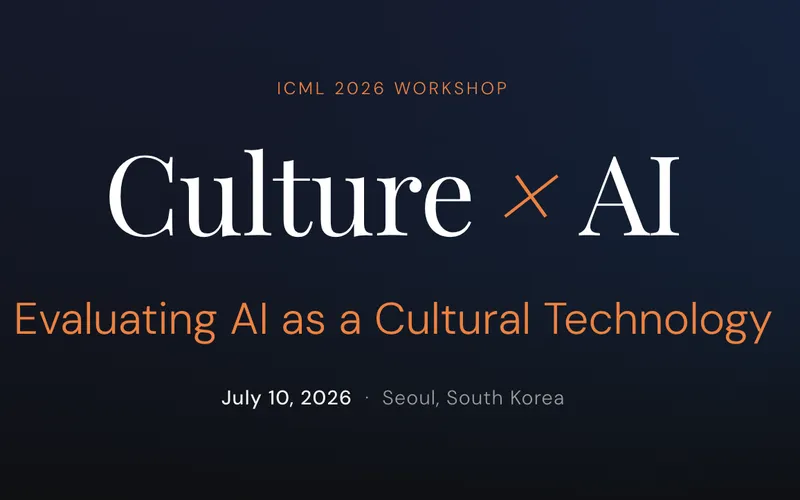
2025: Computational Hermeneutics: Evaluating Generative AI as a Cultural Technology. Cody Kommers et al.
2025: Provocations from the Humanities for Generative AI Research. With Lauren Klein, André Brock, Maria Antoniak, Melanie Walsh, Jessica Marie Johnson, Lauren Tilton, and David Mimno.
2025: Poetry’s Data: Digital Humanities and the History of Prosody, Princeton University Press
“Grief” Paideuma: Modern and Contemporary Poetry and Poetics Volume 50 / 2023 [2025]
2024: Martin M. Command Lines for the Humanities. PMLA/Publications of the Modern Language Association of America. 2024;139(3):541-547. doi:10.1632/S0030812924000555
2024: “Graduate Students and Project Management: A DH Perspective” with Rebecca Munson and Natalia Ermolaev in Digital Futures of Graduate Study in the Humanities, edited by Anouk Lang, Gabriel Hankins, and Simon Appleford. Minneapolis: University of Minnesota Press.
2023: “The Writing of Sound” in The Sound of Writing edited by Christopher Cannon (Johns Hopkins) and Steven Justice (Berkeley). Baltimore: Johns Hopkins University Press, 127-150.
2022 “AI off the Rails: A Response to ‘AI and the Everything in the Whole Wide World Benchmark,’” Critical AI@Rutgers (blog), April 15, 2022.
2021 “The Poetry of the Past” Avidly, a channel of the Los Angeles Review of Books.
2021 “The Poetry of the Future” January 29. Avidly, a channel of the Los Angeles Review of Books.
2021 “Prosody and Metre: Twentieth Century” with Ben Glaser, Yale University Oxford Bibliographies in British and Irish Literature.
2020 “Prosody,” in Oxford Encyclopedia of Literary Theory (part of the Oxford Research Encyclopedia), April 30, 2020.
Related projects
Modeling Culture: New Humanities Practices in the Age of AI
A year-long seminar for faculty and grads with a public lecture series, culminating in a comprehensive and accessible curriculum for advanced humanities researchers.

Exercises in Literary Style
Investigating the capacity of LLMs to discern and classify literary styles through a series of controlled experiments


Related events
Faculty Discussion: AI and the Humanities: A Framework for Language and Literary Scholarship

Related posts

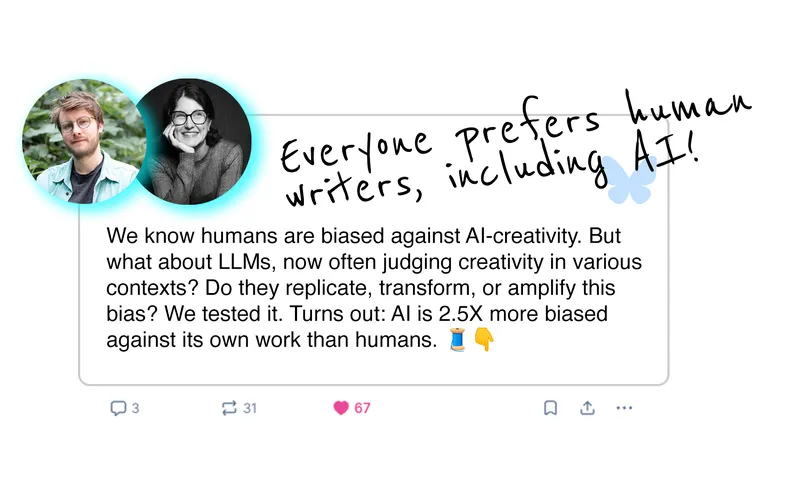
New research shows everyone prefers human writers, including AI!
12 November 2025
Meredith Martin, Wouter Haverals