Joint Graduate Certificate Colloquium: Data and Computation
–
Speakers
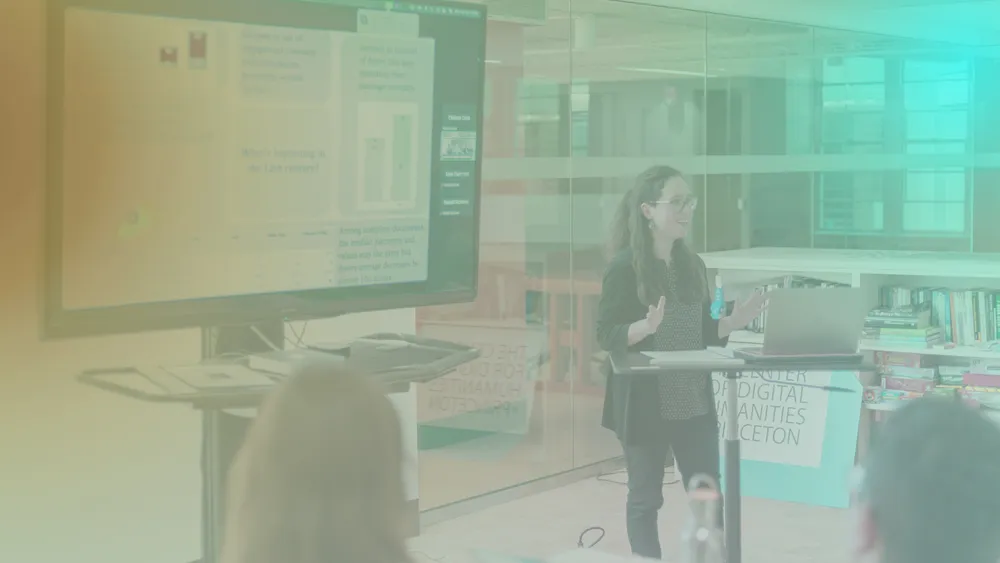
Rachel Richman (NES) presenting at the 2025 CDH Annual Graduate Colloquium
We are pleased to announce the joint Graduate Certificate Colloquium with the Princeton Institute for Computational Science & Engineering (PICSciE), the Center for Statistics & Machine Learning (CSML), and the Center for Digital Humanities (CDH).
The joint colloquium is an opportunity for graduate students completing certificates in Computational Science & Engineering, Statistics & Machine Learning and Digital Humanities to give a presentation on their dissertation research focusing on its computational or statistics and machine learning components.
The presentations are designed to be accessible to the broader University community with an interest in any domain touched by data, computation or statistics and machine learning. Each research presentation will be approximately 20 minutes including time for questions from the audience.
Abstracts by CDH certificate grads
Laura Nelson
Department of History
What happens after we “name names” in large-scale historical datasets? This presentation draws on Seen/Unseen, a digital humanities project that reconstructs the lives of more than 800 enslaved people in antebellum Georgia using archival records from the Howell Cobb Family Papers. Building interconnected datasets of individuals and primary sources, the project preserves fragmentary evidence while deliberately maintaining uncertainty rather than imposing false coherence. Yet even at this scale, enslaved people often remain legible only as data—rows, fields, and attributes. I show how Seen/Unseenpairs database construction with collaborative biographical interpretation, in which narrative reorganizes data into historically situated lives. Tracing this movement from archive to dataset to biography, the project highlights the interpretive decisions embedded in data modeling and suggests how digital methods can support, but not replace, humanistic analysis.
Sharifa Lookman
Department of Art & Archaeology
In 1921, the German art historian Wilhelm von Bode denounced the use of x-radiography in art historical studies as “Alles Mumpitz” (all nonsense). In doing so, he denied sculpture’s masked materiality and criticized the use of assisted technologies to see inside bronze, an advent at the time that could problematize important attributions. More than just skepticism over the integration of scientific study, a budding anxiety had developed between the value of sculpture and the truth behind the techniques and people that made it. The incorporation of 3D-imaging technologies (photogrammetry and 3D-scanning) in art and archaeological studies suggests a similar technological reckoning, and yet where radiography moved beneath sculpture’s skin to make seeable the unseen, 3D-imaging as a medium is defined by its very preoccupation with surface and in capturing only that which can be witnessed. Utilizing the late sixteenth- and early seventeenth-century bronze statuette as its central case, this paper explores both the challenges and potential of 3D-imaging as a tool with which to recuperate intermediary techniques in Renaissance bronze casting and to recognize the often-invisible figure of the technician and copyist. Framing sculptural technique as both subject and heuristic and surface as theoretically elastic, this paper also applies scanned surfaces and their digital facsimiles to historical reconstructions, moving the scanner to the foundry, and from bronze to pixel and back again.
April Gilbert
Department of Comparative Literature
The International Society for the Study of Narrative (ISSN; https://www.thenarrativesociety.org/) began in 1984 as the Society for the Study of Narrative Literature. Its mission is "dedicated to the advancement of research about narratives and narrative theory." It has held an International Conference on Narrative annually since 1986. Using various Python libraries and other text analysis tools, I explore the course of narratives and narrative theory through a corpus of over three decades of ISSN conference programs from 1986 to 2025 (incomplete). What concepts in narratology have appeared and waned over the years? Have the terms for certain concepts changed over time? Which authors/works/periods/genres appear are mentioned in presentation titles over time, and are these influenced by trends or events? I hope to show how an excursion into conference data can produce narrative representations of the history of theoretical practice within the context of one academic society.
Past events
Annual CDH Graduate Colloquium, 2025
