Digital humanities for Hellenic studies students tell new stories of a 'lost' Athens neighborhood
21 October 2026

Participants in the 2026 Digital Humanities for Hellenic Studies seminar visit the Ancient Agora of Athens. Photo by Agiatis Benardou.
Originally published on hellenic.princeton.edu
Katerina Labrou spent the first day of a Digital Humanities for Hellenic Studies Summer Institute in a Princeton Athens Center classroom, fusing the past and the future.
Labrou, a doctoral candidate at the Princeton University School of Architecture, began the seminar by delving into rare archival images of a lost Athens neighborhood, Vrysaki — and the cutting-edge digital tools that allow scholars to bring it back to life online.
She was one of a dozen student participants in “Historic Athens in 3D,” held July 6-10 at the Princeton Athens Center. Princeton’s Center for Digital Humanities (CDH) and the Athens University of Economics and Business (AUEB) designed this recurring seminar, which was sponsored by the Seeger Center. The summer institute teaches early-career scholars digital humanities methods for representing archival information and crafting narratives about historical urban spaces, preparing students to create their own digital cultural-heritage projects.
The process of razing Vrysaki to make way for the excavation of the ancient Agora began in the 1930s. The area is located less than two miles from the Princeton Athens Center — so close that the first day of intensive instruction concluded with a visit to the site itself. At the Agora, instructors Vicky Dritsou, adjunct lecturer at AUEB, and Agiatis Benardou, president of the board of directors of European research infrastructure DARIAH-ERIC, offered context as the students traversed the terrain they would spend the next four days recreating on screen.
Labrou found Vrysaki an intriguing and rich case study for exploring topics from archaeology to the evolution of cities. Through immersion in a broad array of tools and methods, Labrou developed both foundational skills and guiding principles for digital humanities projects going foward.
“I achieved my goals of learning more about digital humanities methods through hands-on work on a relevant project, in an intellectually stimulating and collaborative environment,” said Labrou. “I look forward to building on the knowledge and connections gained through the seminar in my future research.”
“I achieved my goals of learning more about digital humanities methods through hands-on work on a relevant project, in an intellectually stimulating and collaborative environment. I look forward to building on the knowledge and connections gained through the seminar in my future research.”
Katerina Labrou, Princeton School of Architecture graduate student
Seminar coordinator Natalia Ermolaev, executive director of CDH, and Bryan Winston, digital scholarship specialist at Princeton University Library, partnered with scholars from the Science and Technology in Archaeology and Culture Research Center at the Cyprus Institute, the CY Cergy Paris Université, and the MSc in Digital Methods for the Humanities program at AUEB, on instruction. They led training in 3D modeling, spatial data, photogrammetry, and AI tools, which the students used to create 3D, information-enriched visualizations of Vrysaki before it was razed.
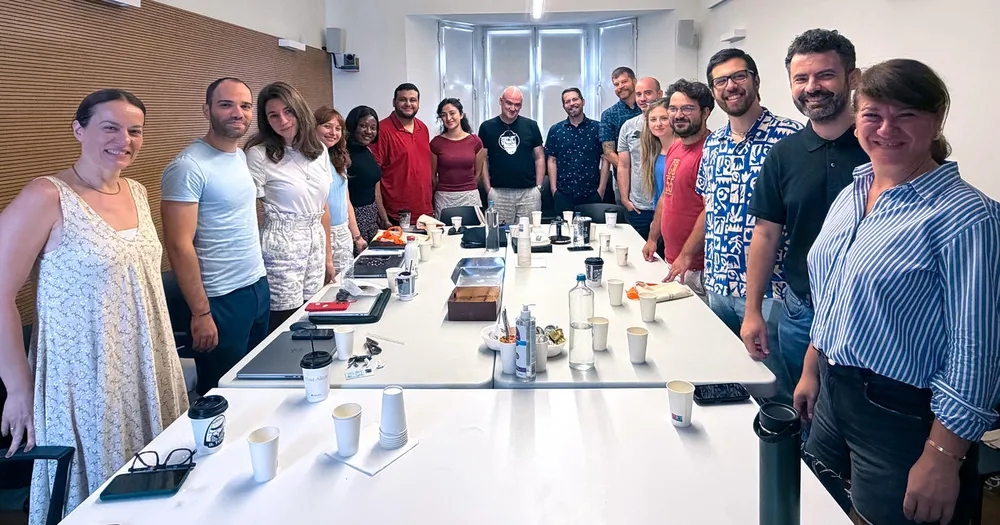
Students and scholars discuss cutting-edge digital humanities tools and methods at the Princeton Athens Center.
On-site learning in Athens also included the opportunity to meet with Sylvie Dumont, author of “Vrysaki: A Neighborhood Lost in Search of the Athenian Agora.” Dumont joined the students at the Princeton Athens Center on the first day of the seminar, discussing Vrysaki and the Agora excavations and answering questions from the students.
Dumont’s work and the Messinesi Photograph Collection, a rare archive of Hellenic material housed in the Visual Resources Collections of the Department of Art and Archaeology, served as sources for the students’ seminar projects. The Messinesi collection is notable for including both archival photos of Vrysaki’s buildings before demolition and a detailed map showing the location of each image. Seminar participants also used a digital map enriched with M. Messinesi’s photos, which was created by the 2025 cohort.
Doctoral and master’s students from Princeton and universities in Greece — specializing in fields from architecture to computer science to cultural-heritage conservation and management — participated in the seminar. They formed three- or four-person teams to collaborate on the digital reconstructions. Each team brought together members from Princeton and institutions in Greece, including the University of Crete, Aristotle University of Thessaloniki, and AUEB.
“It was remarkable to see the collaborative energy in the room, as students from different disciplines and institutions came together around the shared topic of the Vrysaki neighborhood. Learning how to integrate AI into spatial history methods critically and responsibly is essential for today’s scholarship, yet there are very few opportunities for students to gain that training in an interdisciplinary setting. The Digital Humanities for Hellenic Studies Summer Institute offered exactly that opportunity, and the work the teams produced in just five days was truly impressive,” said Ermolaev.
“It was remarkable to see the collaborative energy in the room, as students from different disciplines and institutions came together around the shared topic of the Vrysaki neighborhood. Learning how to integrate AI into spatial history methods critically and responsibly is essential for today’s scholarship, yet there are very few opportunities for students to gain that training in an interdisciplinary setting. The Digital Humanities for Hellenic Studies Summer Institute offered exactly that opportunity, and the work the teams produced in just five days was truly impressive."
Center for Digital Humanities Executive Director Natalia Ermolaev
Labrou’s team reconstructed the area around the Stoa of the Giants in the Ancient Agora. Another team, which included Princeton University School of Architecture Ph.D. candidate Iason Stathatos, playfully cast a cat in the role of tour guide through a recreation of the Agora excavation project’s headquarters.
“I was impressed with how quickly the students coalesced as they developed their projects. Their varied skill sets and disciplinary training made for thoughtful projects that told intriguing stories about Vrysaki,” said Winston.
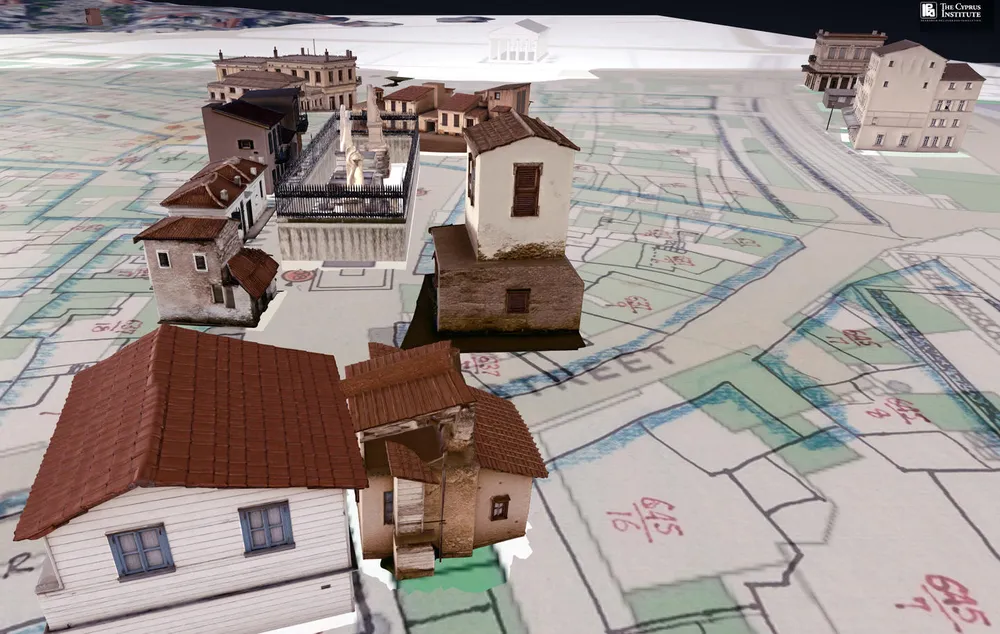
A blend of digital reconstructions of a “lost” Athens neighborhood, Vrysaki, by participants in the 2026 Digital Humanities for Hellenic Studies Summer Institute.
Rafail Giannadakis, a research assistant on the EU-funded TALOS digital humanities project at the University of Crete, found the discussions about deploying digital tools, especially AI options, highly relevant to his research. He noted that participants were encouraged not to view digital tools as neutral technologies. Instead, they explored how a researcher’s choices and theoretical frameworks informed the use of these tools.
“These conversations helped us distinguish between tasks that may benefit from computational assistance and those that continue to require human judgement, contextual knowledge, and critical interpretation. I found this balanced approach particularly valuable because it avoided both uncritical enthusiasm and complete rejection. It encouraged me to consider more carefully how AI can be incorporated into research workflows without replacing scholarly responsibility,” said Giannadakis.
For Naomi Owokotomo, a master’s candidate in archeological materials science at Aristotle University of Thessaloniki, the seminar prompted questions about how to restore communities that have been lost to development. She enjoyed the opportunity for intensive collaboration on a digital model that highlighted the impact of Vrysaki’s architecture on its social and commercial life.
“This was an exciting and transformative experience that challenged both my creative and technical thinking. I was fascinated by what we were able to accomplish in such a short time,” said Owokotomo.
“This was an exciting and transformative experience that challenged both my creative and technical thinking. I was fascinated by what we were able to accomplish in such a short time."
Aristotle University of Thessaloniki master's candidate Naomi Owokotomo
The Seeger Center sponsored the seminar in collaboration with CDH, the Library, the UNESCO Chair on Digital Methods for the Humanities and Social Sciences, AUEB, the MSc Program in Digital Methods for the Humanities at AUEB, and the Digital Research Infrastructure for the Arts and Humanities (DARIAH-EU)