Meet Senior Thesis Prize Co-Winner Alison Fortenberry ’26
20 August 2026
The Center for Digital Humanities Senior Thesis Prize honors exceptional work that substantially engages with or contributes to the field of digital humanities.

Congratulations to Alison Fortenberry, co-winner of the 2026 CDH Senior Thesis Prize! Alison recently graduated with an A.B. in African American Studies with minors in Religion, American Studies, and English. Her thesis, entitled “Until Change Comes: The Hidden History of Denominational Formation and Racial Exclusion in Twentieth Century American Pentecostalism,” was advised by Wallace Best (African American Studies).
We asked Alison about her award-winning work.
Tell us about your project. How would you summarize it in two to three sentences?
My project explored the racialized formation of American Pentecostal denominations in the early twentieth century. American Pentecostalism began as an interracial revival movement largely led by African Americans, but it soon split into racially segregated denominations. My thesis argued that, for White Pentecostals, denominationalism was a project of racial exclusion and racial differentiation.
How did you get interested in your topic?
I grew up in a Pentecostal church, and three years ago, one of my mentors in the congregation passed away. At her funeral, her family insisted that her church membership card be added to a church archive, explaining that members of their family had been historically denied access to the church because they were Black. This surprised me, because the church I grew up in was predominantly Black, and our existing church histories obscured the church’s exclusionary past. I wanted to correct those church histories. At first, the project began just as an effort to make a church archive (to date, I have cataloged and digitized tens of thousands of church records), but as I read through church records and began to explore broader literature about the denomination’s history, I realized that I wanted to make this story the focus of my thesis. [Check out this link to explore some of the items Alison digitized from the church archive.]
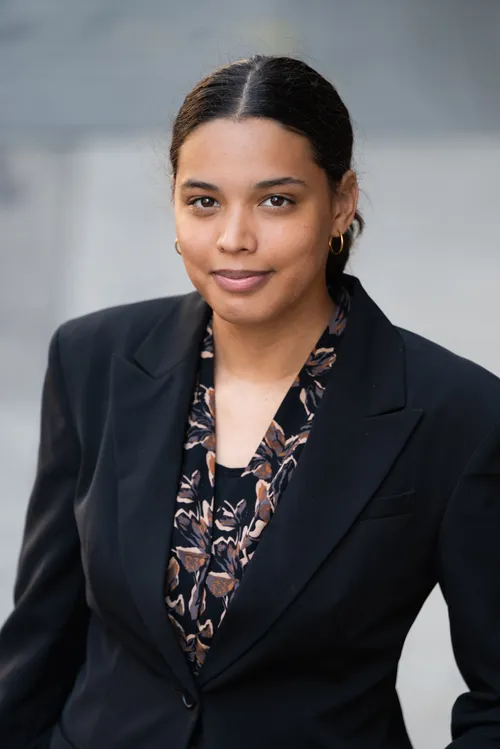
Alison Fortenberry ’26
What role do digital humanities methods play in your analysis?
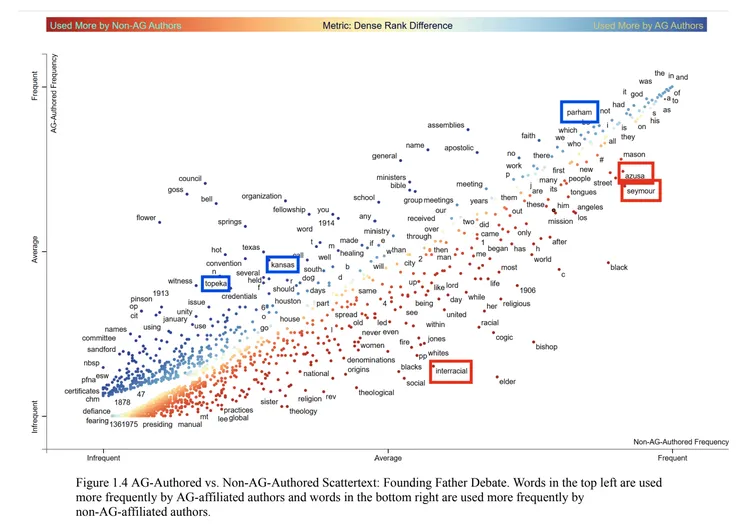
I tried to let the archive and broader corpus of literature I was drawing on guide my use of digital humanities methods in my analysis. A major component of my thesis was a historiography of a predominantly White American Pentecostal denomination, the Assemblies of God (AG). As I got into American Pentecostal literature, I noticed that historical authors who were affiliated with the AG tended to write the denomination’s history much differently than authors who were not, often downplaying the AG’s role in segregating an interracial religious movement. While I was able to demonstrate the differences in AG-authored histories through close readings, I wanted a way to quantify these trends. I worked with Andy Janco in Digital Scholarship to develop a Scattertext project, which tracked how frequently authors of different denominational backgrounds used specific words, then plotted them on a graph. With Scattertext, I was able to demonstrate that AG-affiliated authors use the names of Pentecostalism’s early Black leaders, for example, at disproportionately low rates.
What was a challenge you overcame as you worked on your project?
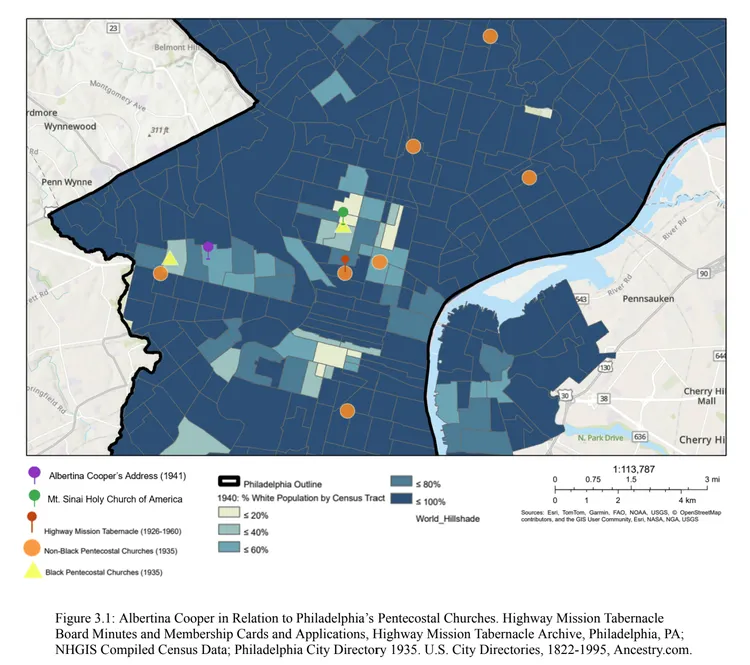
A major goal of my project was to reconstruct the lives of Black Pentecostals in White churches who had been excluded from White church archives. One of my subjects, Albertina Cooper, was a Black woman who attended a White church for over thirty years, yet in an archive of tens of thousands of objects, her name was only listed four times. Trying to flesh out the motivations and feelings behind her decisions was challenging. For example, I wondered why Albertina chose to attend this discriminatory White church when there were other Pentecostal churches in the city, and I assumed that maybe this was just the closest Pentecostal church to her home. I was able to use archived church minutes and a Philadelphia city directory to map Albertina Cooper’s home in relation to all of the city’s Pentecostal churches in the 1930s. I was surprised to find that the closest Pentecostal church to Albertina’s home was actually a Black Pentecostal church and that Albertina had to travel over three miles to get to her White congregation. Albertina’s choice to attend her church was not just a matter of convenience, but an active decision to be the only Black member of a White congregation. Digital mapping helped me reconstruct Albertina’s life and motivations in the face of archival silences.
What was one surprising thing you learned in the process—either about yourself or about your topic?
Through this process, I was surprised to learn that, even as someone with more traditional humanistic training and interests, digital tools are accessible to me. I never thought that I had the ability to conduct more quantitative or computational research, but with the help of Digital Scholarship, the Maps & Geospatial Information Center, and the Center for Digital Humanities, I was able to incorporate digital humanities methods to deepen and extend my qualitative research.
How might your work on your thesis inform your future?
This fall, I’m returning to Princeton to begin a PhD program in the Department of Religion. I plan to continue using methods from the digital humanities in my doctoral work and beyond.
Read about co-winner Christina Li ’26 here.